 By Gustavo Torres
A company that makes invoicing software, call it Albarán, has an internal assistant for its support team. Someone on the team asks it:
Is the customer on ticket 4812 entitled to a refund?
And the assistant answers, with two citations:
No. The annual charge was made on 14 August and the refund window is 14 days from the charge, so it closed on 28 August. [Ticket 4812] [Refunds FAQ]
Both citations exist, and both say what the answer says they say. Ticket 4812 belongs to Ortega Hardware, which paid its annual renewal on 14 August and asked for a refund on 2 September. The FAQ says, word for word, that "as a rule, refunds can be requested within 14 days of the charge". And the answer is wrong. Ortega Hardware is on the Team plan, and the terms of that plan, in another document in the same index, give annual subscriptions 30 days. The window closes on 13 September; the request came in eleven days before that.
The case is invented, but there's nothing unusual about it. Nobody wrote bad code. The assistant searches the company's documents before answering, which is what the RAG pattern (Retrieval-Augmented Generation) proposes, and its search is good: it found the right ticket by its number, which many don't manage. Something else failed. To find the rule that applies, it had to search for "Team plan", and the word "Team" isn't in the question: it's inside the ticket, that is, inside the result of the first search. A system that searches once, with the question as it arrives, can't write that second query. Someone has to read the first result and decide what to search for next.
The story of RAG since 2020 is usually told as a ladder: naive RAG, advanced RAG, hybrid RAG, agentic RAG, each rung better than the last. The ladder mixes two things. One is the quality of the search: what it finds when you give it a query. The other is control: who decides whether to search, what to search for, where, and when enough searching has been done. Hybrid RAG improves the first, agentic RAG changes the second, and Albarán's assistant shows that one doesn't replace the other: it had the best search in this whole article, and with it gave the most convincing and most wrong answer.
The control axis, at a glance:
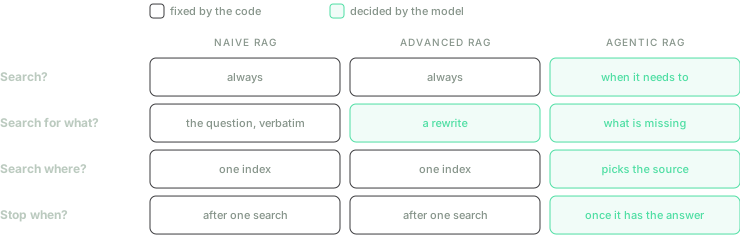
In naive RAG, all four decisions are written into the code before the first question arrives. Each generation hands some of them to the model. The order of the columns is logical, not chronological: ReAct, the basis of the agentic one, was published two months before HyDE, one of the advanced techniques.
What the model doesn't know, and three ways to give it
A language model knows what it learned in training, and it knows it in a particular way: spread across its weights, with no record of where anything came from. That has three consequences no improvement to the model fixes. It knows nothing after the date its data was frozen. It knows nothing that wasn't public: ticket 4812 was never on the internet. And it can't say where what it says comes from, because it doesn't come from anywhere in particular: a citation written from memory is one more generated sentence, as plausible and as impossible to check as the rest.
There are three places to put the knowledge it lacks.
| In the weights (fine-tuning) | All in the context | In an index (RAG) | |
|---|---|---|---|
| Updating a document | retrain | edit the text | re-index that document |
| Cost of each question | unchanged | proportional to the whole corpus | proportional to what is retrieved |
| Can cite the source | no | yes | yes |
| Deleting a fact | no reliable way | remove it from the text | remove it from the index |
The weights are the wrong place for facts. Fine-tuning is good at teaching ways of doing things: a tone, a format, a domain's vocabulary. For specific facts it's expensive, slow and opaque. Every policy change calls for retraining, there's no way to check exactly what it learned, and if a customer asks for their data to be deleted, there is no operation that takes it out of a set of weights.
The context is the option that million-token windows have made serious, and it deserves more than a quick dismissal. If the corpus fits whole and changes little, pasting it into every request with the provider's prompt caching turned on can come out cheaper and more reliable than any index, because there's no search to fail. It stops working on three fronts. Cost and latency grow with everything you paste, on every question, whether you need it or not. A company's documents don't fit: a year of support tickets won't go into any window. And having the fact in the context doesn't guarantee the model uses it. Lost in the Middle measured in 2023 that accuracy drops when the relevant information sits in the middle of the context rather than at the start or the end, and in its experiment with questions over twenty documents, GPT-3.5-Turbo did worse with the right document in the middle than with no documents at all.
The index is the middle ground. The documents are cut into pieces ahead of time and, on each question, the few relevant pieces are found and only those are pasted in. Each question pays for what it retrieves, not for everything there is; knowledge is updated by re-indexing a document, without touching the model; and the answer can cite the exact piece it comes from. The price is that there's now a search in the middle, and a search can fail. Everything that follows comes from there.
The original pattern
The name comes from a 2020 paper, Retrieval-Augmented Generation for Knowledge-Intensive NLP Tasks, and what it proposed was more ambitious than what's called RAG today. It put two pieces together. The first was a dense retriever, DPR, which turns the question and each passage into a vector, with one encoder for each, and finds the passages whose vector lies closest to the question's. The passages were 21 million chunks of Wikipedia. The second piece was a generator, BART: a 400-million-parameter language model published by Facebook in 2019. In RAG, it read the question together with the retrieved passages and wrote the answer. And the paper trained the two pieces together: the error in the final answer was propagated back to the question encoder, so the retriever learned to fetch what the generator found useful. It only kept the document encoder fixed, and for a practical reason: if it changed, all 21 million passages would have to be re-encoded at every training step.
What industry adopted was the name and the shape, not the training. The RAG that gets built today pairs an embedding model from one provider with a language model from another, which have never met, and joins them with a prompt. It's worth keeping in mind, because it explains a good share of the failures in the next section: the retriever doesn't know what the generator needs. It looks for what resembles the question and trusts that that's what's needed.
That version has two lanes:
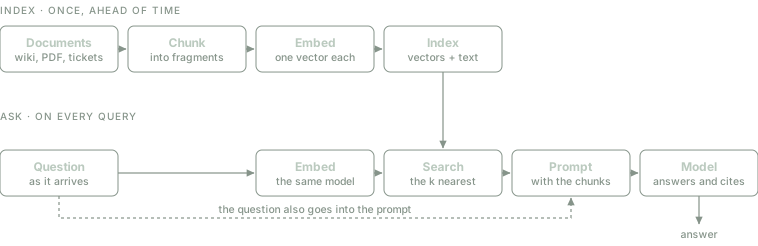
Naive RAG. Top, what's done once; bottom, what's done on every question. The two "Embed" boxes share a column because they have to be the same model: a question and a chunk can only be compared if they live in the same space. The gap between "Question" and "Embed" isn't an oversight; it gets filled later on.
Indexing is work done ahead of time. The documents are cut into chunks of a few hundred words, usually with some overlap between one and the next; each chunk goes through an embedding model that turns it into a vector, and the vectors are stored in an index alongside the text they come from. What an embedding is, and why closeness between vectors reflects closeness in meaning, is the subject of this lesson in the NLP course; here it's taken as known. Chunk size is the first decision with consequences: a large chunk dilutes its vector, which ends up standing for the average of several ideas, and a small one loses the context that gave it its meaning.
Asking is the path walked every time. The question goes through the same embedding model, the index returns the chunks whose vectors are closest (by cosine similarity, almost always) and a prompt puts the question together with those chunks and an instruction along the lines of "answer using only these chunks, cite which one each claim comes from and, if the answer isn't there, say so". The model generates the answer.
Written as code, the question's path fits in two lines:
def answer(question, index, k=4):
    chunks = index.search(embed(question), k)
    return model(prompt(question, chunks))
Look at what those two lines decide without asking anyone. It always searches, even if the question is "thanks". It searches for the question exactly as the user wrote it. It searches a single index. And it searches once: the chunks that come back are all the model will ever see. Those are the four rows of the table at the start, and here they're written as constants.
Where naive RAG breaks
If Albarán's question goes through those two lines, the index returns the refunds FAQ first, which looks a great deal like a question about refunds, and then two tickets from other customers who also want their money back, 4821 and 4182. Ticket 4812 comes fourth, below the cut. The model, being honest, gives the only answer it can: that the general window is 14 days and that it can't find the details of ticket 4812. It isn't a wrong answer. It isn't an answer either.
That's one of the failures. In practice there are six, and each one happens in a different place in the drawing:
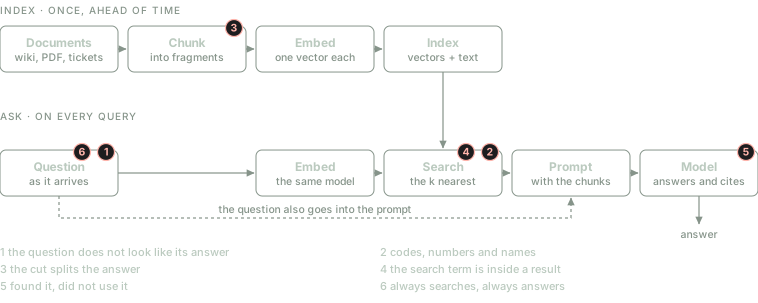
The six failures of naive RAG, each where it happens. Two land on "Search", but they aren't the same: 2 is about aim, 4 is about having only one shot.
- The question doesn't look like its answer. A question is short and interrogative; the chunk that answers it is long, declarative and uses the document's vocabulary. "Do I get my money back if I cancel?" and "Annual subscriptions may be refunded in full within the period…" are about the same thing, but their vectors needn't be close: the embedding model measures resemblance, and a question resembles other questions more than it resembles its answer.
- Codes, numbers and proper names. An embedding summarises meaning, and a ticket number has no meaning to summarise: it's a few tokens among hundreds, and to the model 4812, 4821 and 4182 are nearly the same. Among tickets that all say "the customer is asking for a refund", the order is decided by the other words. The same goes for product references, error codes, versions and surnames: what the user types exactly, the search returns approximately.
- The cut splits the answer. Chunking knows nothing about structure. If the table of refund windows starts at the end of one chunk and its rows fall into the next, the chunk with "30 days" no longer says which plan it refers to, and neither chunk answers the question on its own.
- The term needed for the search is inside a result. This is Albarán's failure. The question says "4812"; the rule that answers it says "Team plan"; what connects the two is inside the ticket. No single search, however good, can write a query with a word it hasn't read yet. The literature calls these multi-hop questions.
- It finds it and doesn't use it. The right chunk reaches the prompt, but fifth out of eight, or next to another that says something similar with more confidence, and the model follows the other one. It's the effect Lost in the Middle measured, plus a problem no retriever solves: two documents that contradict each other, like an FAQ that says "as a rule, 14 days" and terms that say "30 days" for a specific plan.
- It always searches, and always answers. The code searches on a "thanks" and on "summarise what we've been talking about". And at the other extreme, when what the search returns has nothing to do with the question, the prompt hands those chunks over anyway, and a model that's been asked to answer with them tends to answer with them.
Each failure has a fix, and they don't all live in the same place:
| Failure | What fixes it | Where it's covered |
|---|---|---|
| 1. The question doesn't look like its answer | rewriting the query, HyDE | Fixing the question |
| 2. Codes, numbers and names | lexical search alongside dense | The other axis |
| 3. The cut splits the answer | contextual chunks | The other axis |
| 4. Multiple hops | searching inside a loop | Agentic RAG |
| 5. It finds it and doesn't use it | reranking, fewer and better chunks, judging what's retrieved | The other axis and Judging what comes back |
| 6. It always searches | letting the model decide whether to search | Agentic RAG |
The other axis: what the search finds
Two of the six failures, 2 and 3, are about aim: the search doesn't bring back something that exists. They're fixed without handing any decision to the model, by improving the retriever, and the main fix is much older than RAG.
Before embeddings, searching meant counting words. Lexical search, whose standard-bearer is BM25 (from the mid-nineties, and still Elasticsearch's default algorithm), scores a document by the query terms it contains, with three corrections: a rare word weighs more than a common one (finding "4812" says far more than finding "customer"), repeating a word adds less each time, and a long document doesn't win for having more words alone. It knows nothing about meaning: to BM25, "refund" and "money back" are unrelated. But what dense search does badly, BM25 does well by construction: if the document contains "4812" and so does the query, it finds it.
The two searches fail on different questions, and that's what makes combining them useful. The problem is how. Their scores can't be added: cosine similarity lives between −1 and 1, and BM25's score has no ceiling and depends on the corpus. The usual solution ignores the scores and looks at the positions instead. Reciprocal rank fusion (RRF, from 2009) gives each document the sum, over every list it appears in, of
with . (The original paper calls it ; here it would share a name with the in chunks, and the two have nothing to do with each other.) The constant flattens the differences: being first in a list is worth and being fourth is worth , so a document ranked well in both lists beats one that's first in one list and absent from the other. RRF rewards agreement.
With Albarán's question:
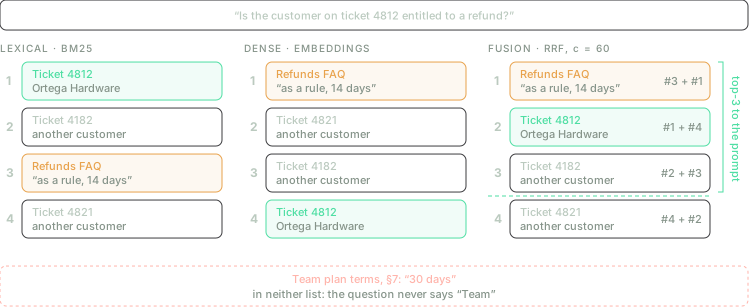
BM25 puts ticket 4812 first because it's the only document that contains "4812"; dense search leaves it fourth. Fusion lifts it to second and gets it above the cut. The Team plan terms appear in neither list.
This is the retriever from the start of the article. It fixes failure 2: the right ticket reaches the prompt. And the model, which now has the charge date and a 14-day rule, does the arithmetic and answers "no", with two citations. Improving the search has turned an honest non-answer into a wrong answer that's sure of itself: the model now has enough material to sound convincing, and it's still missing the one fact that matters.
Around the fusion there are two more pieces that almost every serious system ends up using.
Reranking. The embedding model encodes the question and each chunk separately, which is why it's fast: the chunks are encoded once, at indexing time. A reranker (almost always a cross-encoder) reads the question and the chunk together, as a single text, and scores how well one answers the other. It's far more accurate and far slower, so it's used in two stages: hybrid search brings back fifty or a hundred cheap candidates and the reranker picks the five that reach the prompt. Fewer chunks, and better ones, also go after failure 5.
Contextual chunks. For failure 3, the most effective idea of recent years is to write, before indexing, one or two sentences that place each chunk within its document ("This chunk belongs to the Team plan terms, section 7, refunds") and paste them in front, for the embedding and for BM25 alike. Anthropic published it in 2024 as Contextual Retrieval, with numbers: in their tests, the share of searches that failed to bring back the needed chunk among the top twenty fell from 5.7% to 2.9% with context in both searches, and to 1.9% with a reranker added.
All of this is worth an article of its own, with numbers measured on Spanish text. What matters for this one is what it doesn't do: none of these techniques changes who decides. A hybrid search with context and a reranker still searches every time, once, with the question as it came. It's the same two-lane diagram with a better retriever inside.
Fixing the question before searching
The first step along the control axis is a small one: letting the model touch the query before it goes out to the index. The rest of the pipeline stays the same. It's what the 2023 survey that named the stages called advanced RAG, and it groups several techniques with the same shape.
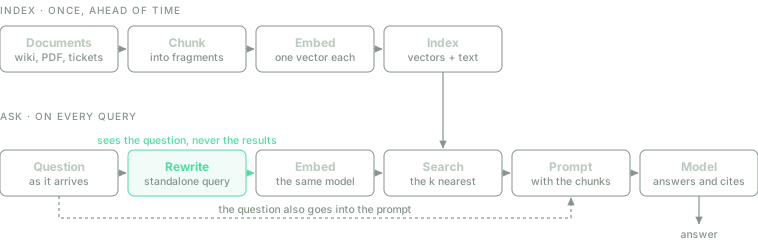
The gap in the query lane, filled. It's the first decision to move from the code to the model, and the model makes it blind: it sees the question, never the results.
Rewriting. In a conversation, most questions can't be searched as they stand. After talking about ticket 4812, "what about the one the same shop opened yesterday?" contains nothing an index can find. A step beforehand in which the model reads the conversation and writes a standalone query ("Ortega Hardware tickets opened on 25 September") is probably the highest-return improvement in the whole article, and one of the most overlooked.
HyDE. Against failure 1, HyDE (Hypothetical Document Embeddings), published at the end of 2022 by researchers at Carnegie Mellon and the University of Waterloo, turns the problem around, and the name gives it away: if a question doesn't look like its answer, have the model first write an invented answer, a hypothetical document, and search with that. Answers look like answers. Whatever the invented answer claims doesn't matter, even if it's false, because nobody reads it: its only job is to land, in embedding space, near the chunks that say things in that form.
Multiple queries. The model writes three or four phrasings of the same question, each one is searched, and the lists are merged with RRF, the same fusion as in the previous section.
Decomposition. A compound question is split into sub-questions and each one is searched. And here the limit of this whole family shows up. With Albarán's question, the natural decomposition is "which plan is the customer on ticket 4812 on?" and "what's the refund window for that plan?". The second can't be searched: "that plan" isn't a query. To write it properly you have to know the plan is Team, and that's known after the first search, not before. All of this preparation happens blind, before a single result has been seen. As soon as one query depends on what another returned, rewriting isn't enough: the model has to be consulted again after searching, and that's no longer a straight line. It's a loop.
Agentic RAG: the model decides when and what to search
The change is one of shape. Instead of a pipeline in which the search happens at a fixed point, the model works in a loop and search is a tool it can call. It reads what it has, decides whether anything is missing and, if something is, writes the query and chooses where to send it. The result comes back into its context as an observation, and the model decides again. When it judges it has what it needs, it answers.
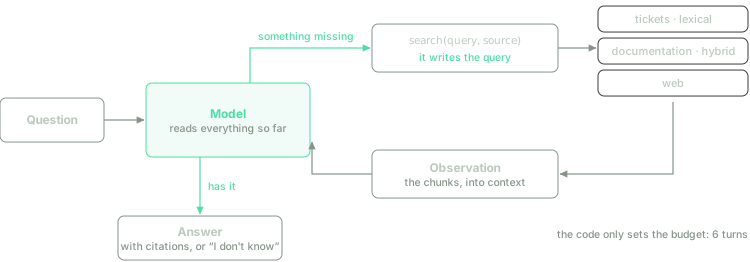
The pipeline turned into a loop. What's green, the model decides on every turn; all the code has left is to set a limit.
The idea has a date. ReAct (from Reasoning and Acting) is a prompting method published in October 2022 by researchers at Princeton and Google. It doesn't need any training: with a few examples in the prompt, the model learns to alternate reasoning steps with actions. In the paper, the actions were calls to the Wikipedia API (search for a page, look up a string within it, finish), and the goal was to answer the multi-hop questions of HotpotQA, a set of 113,000 questions published in 2018 and built so that each answer requires combining facts from two different Wikipedia articles. A couple of months later, IRCoT (Interleaving Retrieval with Chain-of-Thought), another training-free method, from Stony Brook University and the Allen Institute for AI, did the same without calling it an agent: each step of the chain of reasoning served as the query for the next search. What has changed since then isn't the idea but the models, which are now trained specifically to call tools; with that, the loop has stopped being a fragile experiment and become the normal way to build an assistant. It's the same loop as any agent's, and the course on language models and agents builds it piece by piece. What matters here is what changes when the tool is a search engine.
Written as code, next to the two lines from before:
def answer(question, sources, max_steps=6):
    context = [question]
    for _ in range(max_steps):
        step = model(context, tools=sources)
        if step.is_answer:
            return step.text
        results = sources[step.source].search(step.query)
        context.append((step, results))
    return model(context, tools=None).text
The four constants of the naive version have become decisions the model makes on every turn.
Whether to search: it can answer on the first turn without calling anything. What to search for:
step.query is written by the model, after it has read everything before it. Where: step.source
chooses between different indexes. When to stop: when it decides to answer. The code has one
decision left, the step budget, and the last line says what happens when it runs out: the model is
asked to answer with what it has, without tools this time.
With Albarán's question, the run goes like this:
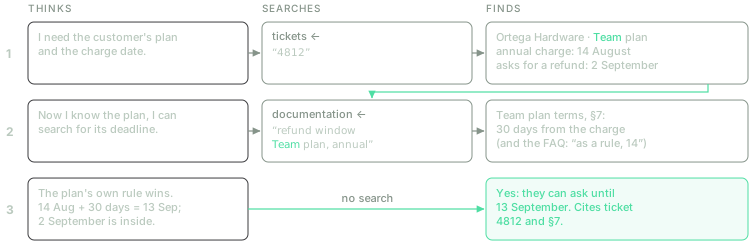
Three turns. The word the second search needed, "Team", comes out of the first search's result. On the third turn it doesn't search: it has both facts and does the arithmetic.
The second turn is the one no pipeline could take. "Refund window, Team plan, annual" is a query nobody could write before reading the ticket. The trace has two more details that matter. The first is that each source is searched with the tool that suits it: tickets by number, with lexical search; the documentation with hybrid search. The axis from the previous section doesn't go away: it moves inside each tool. The second is that the search on the second turn also brings back the FAQ, with its "as a rule, 14 days", and the model has to decide which of the two rules wins.
Judging what comes back
That last point, which is failure 5 and half of failure 6, has its own line of work, older than agents becoming the norm. Self-RAG (Self-Reflective RAG), from 2023, is a training method, and also the models that came out of it: researchers at the University of Washington, the Allen Institute for AI and IBM fine-tuned Llama 2, at 7 and 13 billion parameters, to emit, alongside the text, special reflection tokens: whether it needed to search at that point, whether each retrieved chunk was relevant, whether what it had written so far was supported by it, and whether the answer was useful. CRAG (Corrective RAG), from 2024, doesn't touch the model that generates: it's a piece added to any RAG pipeline, proposed by researchers at the University of Science and Technology of China, UCLA and Google DeepMind. It consists of a lightweight evaluator (a 770-million-parameter T5, fine-tuned for the job) placed behind the retriever, which grades what comes back as correct, incorrect or ambiguous. If it's incorrect, it throws it away and goes to search the web; if it's correct, it trims it before handing it to the generator and keeps only the sentences that matter.
Both are agentic RAG in pieces: decisions the code used to make, made by a model, but at fixed points and with components trained for each one. In a current system, with a general-purpose model that uses tools, the same decisions are asked for in the system prompt ("before answering, check that every chunk you cite is about the case in question; if two sources contradict each other, say which one you're applying and why; if you can't find the answer, say so") and the model makes them inside the loop. That's what happens on the third turn of the trace: the specific plan's rule wins over the general one, and the answer says so.
What it costs to hand over the wheel
None of this comes free, and the price is high enough that agentic RAG shouldn't be the default.
Latency. Each turn is a call to the model plus a search. Three turns are at least three times the wait of one, and the model generates reasoning text on each. For a support question answered in ten seconds it doesn't matter; for autocomplete or a voice assistant, it does.
Tokens. The context grows on every turn: the question, each query and each batch of chunks pile up, and each call pays for everything before it. A six-turn trace with five chunks per search moves tens of thousands of tokens to answer in two sentences.
Non-determinism. The same question, asked twice, can take different paths: a different query, a different source, one more turn. Debugging stops being a matter of looking at what the index returned and becomes reading traces. Without logging every step, a failure can't be reproduced.
Loops. A model that can't find what it's looking for tends to look again with other words, and again. That's why the step budget isn't optional, and why it's worth detecting repeated queries.
A new failure. Giving the model the decision to search also gives it the decision not to. A self-assured model can answer from memory a question whose answer was in the index, and that answer carries no citation to give it away. Naive RAG, for all its flaws, couldn't make this mistake.
With that in view, the choice depends on the questions, not on fashion:
| If your questions… | Use |
|---|---|
| fit whole, with their corpus, in the context, and the corpus changes little | no index: everything in the context, with caching |
| are answered by one chunk and carry no exact codes or names | naive RAG |
| include order numbers, references, error codes or names | hybrid search, with or without a reranker |
| arrive inside a conversation | query rewriting, always |
| need a fact that only appears in another result, or several sources | agentic RAG |
| must be answered in under a second | a fixed pipeline, however good the agent |
The practical rule is to start with the cheapest row that works and move up when a specific failure, seen on real questions, calls for it. And to know which failure it is, you have to measure.
How to tell if it works
A RAG system is two systems, and they have to be measured separately, because their fixes have nothing in common.
The search is measured without the language model. You need a set of real questions (thirty or fifty is enough to start), each with the chunks that answer it labelled by hand. With that, the main metric is recall@k: in what share of questions the needed chunks are among the retrieved. If they aren't, no prompt will fix it. Mean reciprocal rank (MRR) adds where they appear, which matters because of failure 5. For each question, find the position of the first correct chunk and write down its inverse: 1 if it comes first, if second, if third, and 0 if it doesn't appear. MRR is the mean of those numbers. With three questions whose correct chunk comes first, second and not at all, it's . The closer to 1, the higher up the good chunk lands, which is where the model reads it best. It's the same inverse of the position that RRF uses, only here it measures instead of merging.
The answer is measured on chunks known to be good, and the questions are different: whether every claim is backed by a chunk (faithfulness), whether it answers what was asked (relevance), and whether it says "I don't know" when the answer wasn't in what was retrieved. These are usually scored by another model acting as judge, in the style Ragas popularised in 2023, and the judge has to be validated against a hand-checked sample before it can be trusted.
The path is the third thing to measure in an agentic system: how many turns it takes, whether it picks the right source, whether it stops when it should, and whether it answers without searching some question that needed a search.
The separation is what makes the diagnosis useful. At Albarán, the naive pipeline failed at the search: the ticket wasn't in the top , and recall catches that. The hybrid one failed somewhere else: recall for the ticket was perfect and recall for the plan terms was zero. Labelling every source each answer needs, not only the first, is what makes a multi-hop problem visible before it reaches a customer.
What comes next
Three things are moving at once.
Models trained to search. Self-RAG already trained the decision to search; the next step has been to train the whole loop. Search-R1 is a training method published in 2025 by researchers at the University of Illinois, the University of Massachusetts and Google. Its name points to DeepSeek-R1, the model that learned to reason through reinforcement learning, and it does the same for search: it teaches a model (in the paper, Qwen 2.5 at 3 and 7 billion parameters) to interleave reasoning with calls to a search engine, and rewards nothing but a correct final answer. The deep research products that several labs have launched since late 2024, which chain dozens of searches before writing a report, are the industrial version of the same idea. The better the model learns to search, the less behaviour has to be written into the prompt.
Search as one more tool. Protocols like MCP (Model Context Protocol, published by Anthropic at the end of 2024) turn an index into a tool any agent can use without custom code. RAG stops being an architecture and becomes one tool among others, next to the one that queries a database or reads a file, and the agent decides which to use. At Albarán, the ticket tool might not be an index at all: a query to the support database by ticket number is more reliable than any search.
Long context and search, together. Million-token windows haven't killed RAG, but they change its shape: with more room, fewer and larger chunks are retrieved, or whole documents, and failure 3 loses weight. The question has gone from "search, or put everything in?" to "how much to put in after searching?".
What to take away
If you take away one thing, let it be this: the evolution of RAG isn't a ladder, it's two axes. One is what the search finds, and it's improved with lexical search alongside dense, fusion, rerankers and contextual chunks. The other is who decides the search, and it has been moving from the code to the model: first the query, then whether to search, where, and when to stop. A multi-hop question only comes out right with both.
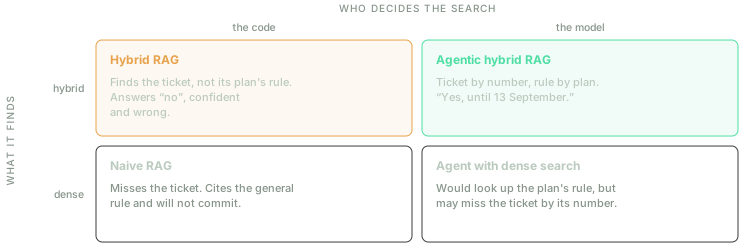
Albarán's question in the four possible systems. Improving only the search makes the answer more convincing without making it correct; only the system with both axes gets it right.
And if you take away three more, let them be practical.
Measure the search before touching the prompt. Thirty real questions with their sources labelled (all of them, not only the first) tell you whether the problem is finding or using what was found. Without that, every change is a bet.
If your users type codes, numbers or names, add lexical search. It's the cheapest improvement in this whole article: BM25 is available in almost every search engine and in many databases, and RRF is ten lines.
Hand the wheel to the model when the question calls for it, not before. Agentic RAG pays for itself when the query you need depends on something you only learn after searching. If your questions are answered by one chunk, an agent charges you latency, tokens and traces to make a decision the code was already making well.