XOR: why we need hidden layers
25 min read
The previous lesson, on activation functions and non-linearity, finished off the neuron: a weighted sum, topped with a curved that has a usable derivative (sigmoid, hyperbolic tangent, or ReLU) in place of the step that filled that slot at the start. Finished, but with one limit none of the three candidates touches: the neuron still answers by which side of a hyperplane the input fell on. That shifts the question elsewhere. It's no longer about which to pick, but a question about the data itself: which arrangements of examples fit inside a hyperplane, and whether there's one that fits inside none at all.
Four phrases are enough to find one. Take it's good, it's bad, not good and not bad, and classify them: the first and last speak well, the middle two speak badly. All four are told apart by exactly two facts (whether not shows up, and whether the evaluative word is good or bad), so two coordinates describe them completely. Now look at what not actually does. It carries no sign of its own: it flips the sign of whatever word follows it. And a weight, by contrast, is a fixed sign.
Those two coordinates fit neatly into the same drawing from the lesson on the artificial neuron: each phrase becomes a point in the plane, its colour marks what it says, and the neuron looks for a line that leaves one colour on each side. The second button of the explorable loads exactly those four points.
The four points sit at the corners of a square, and each class occupies two opposite corners. A line splits the plane into two halves, and there's no way to put two opposite corners in the same half without dragging one of the other two along with them. The explorable shows this; it doesn't prove it. A procedure failing to find a line only tells you the procedure failed, not that no line exists. Every possible line has to be ruled out at once.
Four phrases no hyperplane separates
Let's fix the coordinates. Set when the phrase contains not and when it doesn't, and set when the evaluative word is good and when it's bad. The label is if the phrase speaks well and if it speaks badly, the same two values the step returns.
| phrase | ||
|---|---|---|
| it's good | ||
| it's bad | ||
| not good | ||
| not bad |
The label is exactly when the two coordinates differ. That function has had a name since long before neural networks existed: the exclusive or (XOR), and its two classes are the two diagonals of the square.
Suppose there exist and that let the neuron get all four right. Getting the two positives right means on both, and getting the two negatives right means on both. Add each pair separately, with :
and for the other diagonal, with the same weights,
The weights cancel out in both, and the two sums land on the same number. But the first sum adds two quantities that are , so ; the second adds two quantities that are , so . No single can satisfy both at once, so the neuron you assumed doesn't exist.
It's worth reading that cancellation straight off the drawing, because it shows exactly where it comes from. The two segments, the one joining the two positive phrases and the one joining the two negative ones, share the same midpoint: the origin. And because is affine, its value at the midpoint of a segment is the mean of its values at the two endpoints. The origin would have to fall on the positive side for sitting between two positives, and on the negative side for sitting between two negatives.
The general version: two segments that cross always rule it out
Nothing in the computation above depended on the coordinates being , or on the four points forming a square. Let be two examples of one class and two examples of the other, and suppose the segment joining the first pair crosses the segment joining the second pair at a point . Crossing means that point can be written both ways at once:
with . An affine function distributes cleanly over combinations like these, because the weights sum to and the bias comes through untouched:
If the neuron gets them right, and are both , and , a mean of the two with non-negative weights, must be too. Coming at it the other way, and are both , so has to be as well. The same point, with two incompatible signs.
With this in hand, the result doesn't change if you'd rather encode the phrases with and instead of and : the four points then sit at the corners of the unit square, the two segments cross at , and the exact same contradiction appears.
And no activation fixes it
The proof leaned on the step in exactly one place: to read "gets it right" as or . That's the only thing that needs checking again. Let be strictly increasing (the sigmoid and the hyperbolic tangent both are), and let be whatever threshold you use to read its output as a yes. Being increasing makes it invertible on its range, so is equivalent to , and the set of phrases that get a yes turns out to be
which is exactly the half-plane of the same neuron, only with a different bias, . The proof carries over without changing a single letter.
ReLU isn't strictly increasing, and it doesn't escape the argument either. With , asking amounts to asking , another half-plane; with it holds for every input, and the neuron answers yes to all four phrases, including the two that speak badly. Half-plane or the whole plane, and neither one splits the diagonals.
A layer is several neurons at once
What fails isn't the neuron itself: it's that there's only one of it. Put two neurons in front, both looking at the same input, and a third looking at whatever those two hand back. That leaves three columns, and each one has a name. The input layer is itself and computes nothing (it's drawn as a column of circles by convention, though there are no actual neurons there); the hidden layer is the first two neurons, called hidden because its output isn't the final answer and nobody outside ever reads it; and the output layer is the third neuron, the one that actually answers.
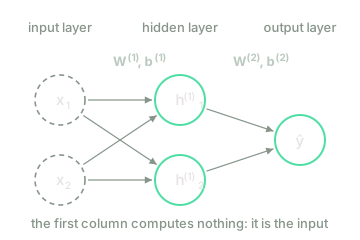
With several neurons at one level, each neuron's weight vector becomes a row. Neuron of layer keeps its weights in row of and its bias in , and what were the scalars and in the lesson on the artificial neuron are now the coordinates and . It's the same object, only stacked; nothing about it has changed on the inside. With , the hidden layer computes
with and , with applied coordinate by coordinate. The output layer does the same thing to :
with and . A layer with a single neuron amounts to a matrix with a single row, and writing it this way costs a couple of extra subscripts now but saves having two separate notations later.
Two parallel lines separate what one alone cannot
These particular weights solve all four phrases, with the step as in both layers:
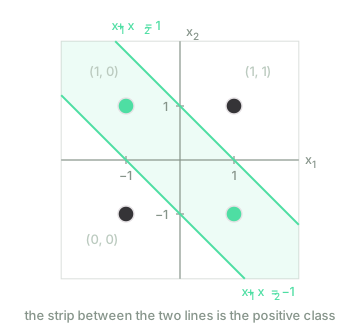
I chose them by hand, the same way I chose the eight weights of the review neuron back in the lesson on the artificial neuron, because nothing in the course yet finds them on its own. And I chose them so they'd be easy to read. The two rows of are identical, so the two hidden neurons look in the same direction, and only the bias tells them apart: the first asks whether , the second whether . They're two parallel lines, and the positive class is the strip running between them. A strip is the intersection of two half-planes, and deciding that intersection is exactly what the output neuron does: asks for a yes to the first and a no to the second.
| phrase | ||||||
|---|---|---|---|---|---|---|
| it's good | ||||||
| it's bad | ||||||
| not good | ||||||
| not bad |
The column is where the result actually shows up. Four input points have come out the other side as only three: , and , and the positive class is exactly the middle one. In these new coordinates there's now a line that leaves one class on each side, and the output neuron does nothing a lone neuron couldn't already do. The hidden layer hasn't added any extra power to decide with; it has changed where the deciding happens.
That's the insight worth holding onto, because the previous block was entirely about the very same thing. There, the representations were chosen by a person (one dimension per vocabulary entry, then counts, then dense vectors), and every choice was a decision written by hand. A hidden layer is one more representation like those, with one crucial difference: its coordinates come out of weights, and weights can be told to adjust themselves. A neural network with at least one hidden layer has a name of its own, the multilayer perceptron (MLP), and it's the one that gives this block its title.
Every line of a grid, and then the network
The cell does two things. First, it tries a whole grid of lines by brute force, to find the ceiling on how many it can get right; then it builds the two-layer network using the weights above and runs it on the four phrases. Run it and compare the two blocks of output.
np.random.seed(0)
# --- The four phrases, with their two coordinates and their label.
phrases = [
("it's good", (-1.0, 1.0), 1),
("it's bad", (-1.0, -1.0), 0),
("not good", ( 1.0, 1.0), 0),
("not bad", ( 1.0, -1.0), 1),
]
X = np.array([coords for _, coords, _ in phrases]) # (4, 2): one row per phrase
y = np.array([label for _, _, label in phrases])
print("X has shape", X.shape, " labels:", y)
print()
# 1. Brute force: 41 values per parameter, every combination.
g = np.linspace(-3.0, 3.0, 41)
G1, G2, GB = np.meshgrid(g, g, g, indexing="ij")
lines = np.stack([G1.ravel(), G2.ravel(), GB.ravel()], axis=1) # (41^3, 3)
Z = lines[:, :2] @ X.T + lines[:, 2:3] # one z per line and per phrase
correct = ((Z >= 0).astype(int) == y).sum(axis=1)
print("lines tried: ", len(lines))
print("most correct: ", correct.max(), "of 4")
print("lines with 3 correct:", int((correct == 3).sum()))
print("lines with 4 correct:", int((correct == 4).sum()))
print()
# 2. The network: two hidden neurons and one output, with the lesson's weights.
W1 = np.array([[1.0, 1.0],
[1.0, 1.0]])
b1 = np.array([1.0, -1.0])
W2 = np.array([[1.0, -1.0]])
b2 = np.array([-0.5])
def step(z):
return (z >= 0).astype(float)
print("phrase".ljust(12), "z(1)".rjust(12), "h(1)".rjust(9), "z(2)".rjust(6), " y_hat", " y")
right = 0
for text, coords, label in phrases:
x = np.array(coords)
z1 = W1 @ x + b1
h1 = step(z1)
z2 = W2 @ h1 + b2
y_hat = int(step(z2)[0])
right += int(y_hat == label)
print(text.ljust(12),
("(%+.0f, %+.0f)" % (z1[0], z1[1])).rjust(12),
("(%.0f, %.0f)" % (h1[0], h1[1])).rjust(9),
("%+.1f" % z2[0]).rjust(6),
"%6d" % y_hat, "%2d" % label)
print()
print("correct:", right, "of", len(phrases))
print()
# 3. The two positive phrases land on the same point of the hidden layer.
h_good = step(W1 @ np.array([-1.0, 1.0]) + b1)
h_bad = step(W1 @ np.array([1.0, -1.0]) + b1)
print("h(1) of it's good =", h_good)
print("h(1) of not bad =", h_bad)
print("same vector?", bool(np.array_equal(h_good, h_bad)))
The first run downloads the Python interpreter (~15 MB). After that it stays in the browser cache and is reused across every lesson.
The grid tries lines. None gets all four phrases right, and of them stop at three. That figure comes with a limit worth stating up front: a grid leaves out every line it didn't try, which is almost all of them, so on its own it proves nothing (that's what the computation above is for, and why it comes first). What the grid does add is the ceiling. Three correct isn't a halfway result that a finer search would eventually fix; it's the actual maximum, and that maximum gets reached all over the grid.
The network gets all four right. The cell's table is the same one shown above, now actually computed, and in it comes out to on the two positive phrases and on the two negative ones, with an identical margin on both sides. The last check prints exactly what the hidden layer does: it's good and not bad, sitting at opposite corners of the input square, both come out as . They started as far apart as two points can be and ended up in exactly the same place.
Test your intuition
Three questions: what the impossibility actually proves, whether the choice of activation has anything to do with it, and an output pre-activation worked out by hand.
Which of these statements proves that no single neuron gets all four phrases right?
Swap the step for the sigmoid and read the output this way: the phrase speaks well when . Under that reading, there is some choice of and that gets all four phrases right.
With the weights the lesson fixes, what is the output pre-activation for the phrase not good, that is, for ?
A margin of ±0.01 is accepted.
I wrote the four numbers in and the three biases by eyeballing the square, and that's the second time this debt has come up. It costs more to settle now, too. With a single neuron, you could at least look at each weight and say which word it had an opinion about; the weights of a hidden layer don't have an opinion about the answer at all, they have opinions about intermediate coordinates nobody ever sees, and whether those opinions are right or wrong only shows up two layers further on. Sharing that responsibility across layers is what the rest of this block is about.
But there's a smaller, more urgent problem first, and it's really a problem of notation. The network in this lesson fits in a table because it only has three neurons; with a vocabulary of fifty thousand entries and a couple of hundred hidden neurons, walking through it neuron by neuron fits on no page, and in no loop worth running. What's needed is a form where an entire layer becomes a product of matrices, with a great many examples passing through that same product at once: that's the next lesson, on the forward pass.
Further reading1 source · 1 book
Where this lesson comes from, and where to go next. None of it is needed to carry on with the course.
- Deep Learning, ch. 6: Deep Feedforward Networks
Its §6.1 works through this same XOR problem with the same two-hidden-neuron network, using ReLU instead of the step: weights set by hand, training left for later. Shows the linear model fails, but does not prove it in general.